
Trip planning
How to choose a dive centre in Dauin and Dumaguete
Six questions that show how invested a dive centre is in the diving, what each answer means for your day, and a checklist to send before you book.
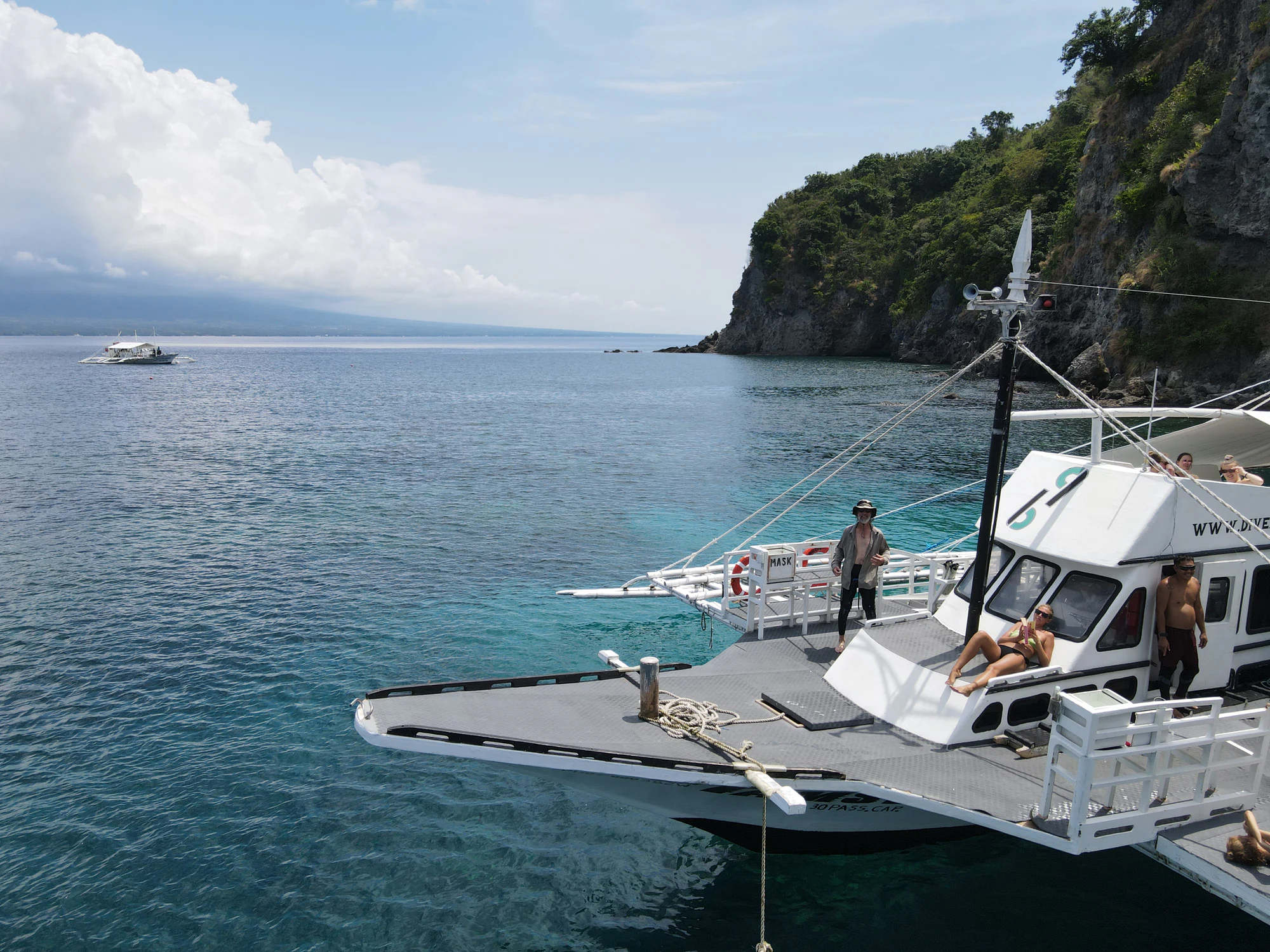
From the coast road, the dive resorts along Dauin look much the same: a sign, a rinse tank, a row of fins drying in the sun. The differences are behind the scenes, and they show up on the day. Whether the Apo Island boat leaves on time. Who is in the water next to you. How many people are on the reef. What happens when something goes wrong. We run a dive centre here, so read our bias accordingly. But the questions below are worth asking any centre you consider, including us, and the answers will tell you more than any website does.
The short version
Before you book, ask six things: who owns the boat, who fills the tanks, whose equipment you will be using, who the staff are and how they are trained, what happens when there are not enough divers for a trip, and when the boat actually leaves. None of the answers is a deal-breaker on its own. Together they tell you how invested a centre is in the diving, as opposed to the rooms.
1. Does the centre run its own boat?
Apo Island is the reason many people come to this coast, and the boat is where a dive day is made or lost. Some centres own their boat and employ its crew. Others book space on a boat run by someone else, and a few boats on this coast make a business of combining divers from five, six or seven different operations on one trip.
When the boat belongs to the centre, the centre decides the departure time, how many divers are on board, which sites you dive and what safety equipment is carried, and the crew know the guides and the routine. On a shared boat none of that is in your resort's hands. You wait for the last group to arrive, you dive with people whose guide met them an hour ago, and twenty divers can end up on the same small reef at the same time.
That does not make shared boats bad; on a quiet day they are sometimes the only way a trip happens at all, and a good partner shop runs a tight boat. It does mean you should ask which boat you will be on, how many divers it carries and who will be leading your group, and be a little wary of a centre that cannot tell you.
2. Who fills the tanks?
This one rarely gets asked and probably matters most. A centre with its own compressor and its own tanks controls the fill, the air quality and the maintenance of every cylinder you breathe from. A centre that collects rental tanks from a supplier each morning knows none of that first hand: how the compressor is maintained, when the air was last tested, when the tank was last inspected, or whether the last fill was short.
Ask where the tanks are filled, whether the air is tested, and whether Nitrox is blended on site. A centre that fills its own tanks will be pleased you asked.
3. Whose equipment is it?
Rental equipment is either the centre's own fleet, serviced by its own people, or borrowed and contracted in. Ask when the regulators were last serviced, whether there are enough sizes to fit you properly, and whether equipment is included in the price or added on. A centre that owns and services its fleet can answer in a sentence.
4. Who are the people?
Dive guides on this coast are either employed by the centre or freelance, hired by the day. Both can be excellent. The difference is what the centre knows about them, how they are trained together, and what happens on a day when the regular guide is not available.
The boat crew matter as much as the guides. On a rented boat the crew are boatmen: skilled with the boat, but not necessarily divers or first aiders. A crew member who is a certified diver and has practised first aid recognises a diver in trouble at the surface, knows what the guide is signalling, and knows where the oxygen is and how to use it. Ask whether the boat crew are certified divers and whether they do regular first aid training. It is a short question with a long answer behind it.
5. What happens when the numbers or the weather don't cooperate?
Every centre has days when only one or two divers want Apo, and days when the sea says no. What you want to know is what the centre does then, and whether it tells you before you book.
The honest answers are: we send our own boat with a small group, we put you on a partner's boat we know and trust, or we move your trip to another day. The answer to be wary of is the one you only discover at 8 AM on the beach. Ask about the Coast Guard clearance, who makes the final call on the weather, and what happens to your deposit if the trip cannot run.
6. When does the boat leave?
A simple question that tells you a lot about how the place runs. A centre that owns its boat, its tanks and its equipment, and employs its crew, can tell you the departure time and keep to it when the weather, the guests and the Coast Guard all cooperate. A trip assembled from four suppliers leaves when the last of them arrives.
How we do it
Here is how Bongo Bongo answers its own questions, so you can compare.
- The boat. We run our own dive boat with our own crew for Apo Island, with a crew member keeping count of everyone in and out of the water, emergency oxygen and a first aid kit on board, and two thirds of the deck shaded. The Apo trip meets at 7:45 AM and leaves at 8:15 AM, when the weather, the guests and the Coast Guard all agree.
- The tanks. We fill our own tanks on our own compressor at the dive centre, including Nitrox for certified Enriched Air divers.
- The equipment. Our own rental fleet, serviced by our own team and included in our dive and course prices.
- The people. Every member of our dive staff and boat crew is at least a certified Open Water diver and does regular Emergency First Response training. Most of our team are from Dauin and trained here: training local people for the dive industry is part of why we exist, and it is why the same faces look after you year after year.
- Quiet days. When there are not enough divers to send our own boat, we place you with one of a handful of partner centres we have dived with for years, and we tell you before you book. We do not use the boats that combine many operations.
- Training. A pool on site and a house reef that starts in a few metres of water, which is why our PADI courses are taught from the shore in classes of two or three.
There are other centres on this coast that run things properly, and we are glad to share the water with them. The point is not that any one place is best. It is that the way a centre is set up decides what your day feels like, and the questions above let you see the set-up before you arrive.
Things that matter less than they look
- A PADI or SSI rating on its own. Ratings describe what a centre offers (the courses, the services, the facilities), not how it runs its boat. Ask the six questions anyway.
- The number of boats. One boat run well beats three that are shared.
- A few hundred pesos on the dive price. The cheapest offer on the coast is usually the one with the most shared parts, or with something left out: the sanctuary fee, the equipment, the fuel surcharge. Compare what is included, not the headline.
- How the website looks. Including ours.
A checklist to copy into your email
Send these to any centre you are considering. A good one will answer all eight without blinking.
- Is the Apo Island boat yours, and who crews it?
- How many divers do you take on an Apo day, and how many per guide?
- Where are your tanks filled, and is the air tested?
- Is Nitrox blended on site?
- Is the rental equipment yours, and when were the regulators last serviced?
- Are your guides employed or freelance, and are the boat crew certified divers with current first aid training?
- What happens if only two of us want to go to Apo on our day?
- What time does the boat leave, and who decides if the weather is not good enough?
Frequently asked questions
Is a dive resort better than a dive shop?
Neither is better by definition. A dive resort with rooms and a restaurant on site makes the days easier, especially for courses and early departures, but what matters is whether the diving side is run in-house or contracted out. Some small dive shops own everything they use; some large resorts own nothing but the rooms. Ask the questions above either way.
What is a consolidator boat?
A boat that sells places to several dive operations and combines their divers on one trip. It can make a trip possible on a quiet day, at the cost of bigger groups, a schedule nobody at your resort controls and guides who do not know each other's divers.
Why do Apo Island prices differ so much between centres?
Mostly because of what is included. Sanctuary fees, equipment, the fuel surcharge, lunch and the guide are each either in the price or added on. Our Apo Island day trip lists exactly what is included, and we suggest asking every centre for the same list.
Can I dive Apo Island from Dumaguete city?
The boats leave from the Dauin coast, 20 to 30 minutes south of the city, and from Malatapay further south. Most divers stay in Dauin so the boat is a walk away; see diving in Dumaguete for how the pieces fit together.
Are centres with their own boat and compressor safer?
Owning the equipment does not make anyone safe by itself; running it well does. What ownership gives you is a centre that controls the whole chain, knows its maintenance history and has nobody else to point at when something goes wrong. Read more about how we keep divers safe in Dauin, including the hyperbaric chamber the town now has.
Thinking about Dauin? See who we are, how our Apo Island day works, or build your dive trip and ask us the eight questions. We like answering them.